Is Jeremy Ethier Legit? Built With Science, Checked
Free check
See if a creator's audience is real — free, no login.
Fitness YouTube runs on the word “science”, and most channels that use it never touch a study. Jeremy Ethier is one of the few who has put his name on one, and the result was not the one his own hypothesis predicted. This is a sourced look at who he is, what Built With Science sells, what that study found, and what his channel’s public numbers look like.
Who he is
Ethier is the founder of Built With Science, which he says he started in 2018 “to weed out the BS and bro-science that the fitness industry is full of.” On the company’s about page he says he took a bachelor’s degree in kinesiology and further training certifications before starting his YouTube channel, and that the company has “over 100,000” people in its fitness programs (Built With Science, About, read October 28, 2026). The page does not name his university or the year he graduated, and we did not find an independent source that does, so we leave both out.
His YouTube channel was created on October 6, 2016, and lists Canada as its country, according to the channel’s own About panel, which on October 28, 2026 also showed 343 videos and 1,193,584,867 total views (YouTube, @jeremyethier).
The business
Built With Science sells training programs, a meal plan and supplements, and its about page lists a coaching team with their credentials (for example NASM and NSCA personal-trainer certifications, and a registered dietitian). That is a normal creator business model: free videos at the top, paid programs underneath. Nothing about it is unusual or hidden; the products are on the site’s own navigation.
What we could not find: revenue, profit or a valuation from any source we would cite. We do not estimate one.
The study he co-authored
The strongest evidence that the “science” label is more than branding is a randomized controlled trial run at the University of British Columbia. “Stretch vs Squeeze: The Impact of Varying Resistance Challenge at Long vs Short Muscle Lengths” lists Jeremy Ethier of Built With Science as a co-author, alongside researchers from UBC’s School of Kinesiology and Bret Contreras (SportRxiv preprint, DOI 10.51224/SRXIV.660, posted November 27, 2025).
Twenty untrained young adults trained for 10 weeks on machines set up so that one limb was challenged hardest at long muscle lengths and the other at short muscle lengths, with growth measured by MRI. Both sides grew. The difference between them did not reach significance for any muscle, and the authors wrote that the findings “fail to support the hypothesis” that biasing the challenge toward longer muscle lengths enhances growth.
Two caveats. It is a preprint, which means it had not been through journal peer review when we read it. And a sample of 20 is small. But a creator whose brand is evidence co-authoring a study that came back null, and publishing it anyway, is exactly the behaviour you would want to see.
By the numbers
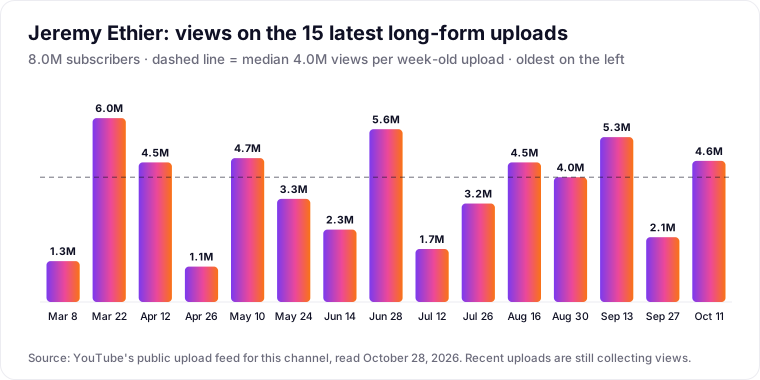
We read his channel’s public data on October 28, 2026 as part of our study of 312 big YouTube channels.
| Measure (October 28, 2026) | Jeremy Ethier | Typical fitness channel in our study |
|---|---|---|
| Subscribers (as YouTube displays them) | 7.98M | — |
| Median views per long-form upload | 4.04M | — |
| Views per subscriber | 50.7% | 4.9% |
| Like rate (likes ÷ views) | 1.87% | 2.17% |
| Long-form uploads, last 30 days | 1 | 2 |
| Median views per Short | 1.49M | — |
The standout number is the first ratio. His typical long-form video earns views equal to about half his subscriber count, against a median of 4.9% for the 53 fitness channels we measured and 7.8% across all 309 channels. That puts him in the top tenth of the whole study. It fits a channel that posts roughly every two weeks and whose videos keep being found through search: the 15 uploads in the window run from March to October 2026, and every one of them had passed 1 million views.
His like rate is a little below the fitness median, which is common for channels whose views come from search rather than from fans (see what a good like-to-view ratio is). Nothing in these public numbers looks like a bought audience; the more typical warning signs are the opposite shape, a big subscriber count with few views.
What our checker would add
Ethier is on YouTube, one of the two platforms our free authenticity checker can score. We did not run it for this article, so nothing here is or implies a score for his channel. You can run it yourself at /check/youtube/jeremyethier; the methodology explains what it measures.
The bottom line
On “is Jeremy Ethier legit?”: the business is transparent about what it sells, his name is on a real controlled trial whose null result was published, and his channel’s public numbers show an audience that watches far more than the fitness-channel norm. What stays unverified is the money, and the degree details beyond what his own company states. For any fitness creator, the useful checks are the same: does the “science” lead to actual research, and do the views match the subscribers? Our guide to vetting a creator before a deal covers the rest.
Sources: Built With Science, About; Jones, Hillen, Fliss, Contreras, Ethier and Mitchell, “Stretch vs Squeeze”, SportRxiv; YouTube channel About panel; YouTube’s public upload feeds for the channel, read October 28, 2026 (study dataset).
Want more like this?
Get new guides and checker updates by email.